What Is a Chicken Breed and How to Identify It
Trying to figure out what chicken breed you have can be tricky, right? You’re not alone—many people struggle with identifying their flock’s breed, especially when there are so many varieties out there. But knowing the breed is key for proper care, choosing the right chickens for your needs, and even predicting egg types.
A chicken breed is a group of chickens with shared physical traits, behaviors, and egg characteristics unique to their kind. You can identify a breed by checking feather color and patterns, body shape and size, comb type, and even their temperament.
Egg color and laying habits also provide clues. Using these features, you’ll quickly know what breed you’re dealing with. Investigate further to uncover how these traits impact care and selection for your flock.
Key Takeaways
- A chicken breed is a group with distinct physical, behavioral, and genetic traits specific to its origin and purpose.
- You can identify breeds by looking at feather patterns, body shape, comb type, leg color, and unique features like Silkie fluffiness or Rhode Island Red’s reddish feathers.
- Eggshell color, size, and production rates also give clues about breed identity and purpose. These details help differentiate layers from dual-purpose chickens.
- Behavioral traits such as temperament, broodiness, and activity levels make it easier to distinguish breeds and match them with the right environments.
- For accurate breed identification and confirmation, use visual cues, vocalizations, leg characteristics, and genetic testing.
What Makes a Chicken Breed Unique?
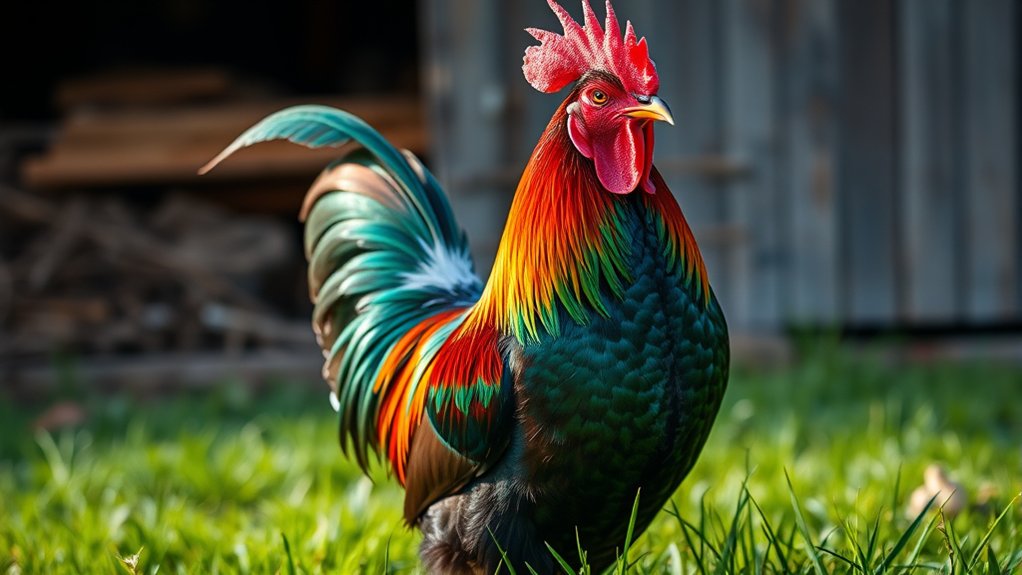
Although many chickens may look similar at first glance, each breed has distinct traits that set it apart. When you’re trying to identify a chicken breed, pay close attention to its feather patterns. Some breeds boast intricate, unique designs like lacing, mottling, or solid colors that make them easy to spot. These patterns aren’t just for show; they help you differentiate breeds quickly and accurately.
You’ll also want to look at the beak shape. Different breeds have variations in size, curve, and color that can clue you in on their identity. For example, some breeds have stout, curved beaks perfect for foraging, while others sport straighter, slimmer beaks. By focusing on feather patterns and beak shape, you sharpen your ability to tell one breed from another. This lets you appreciate the variety in chickens and helps you care for them appropriately.
Why Knowing Your Chicken’s Breed Matters
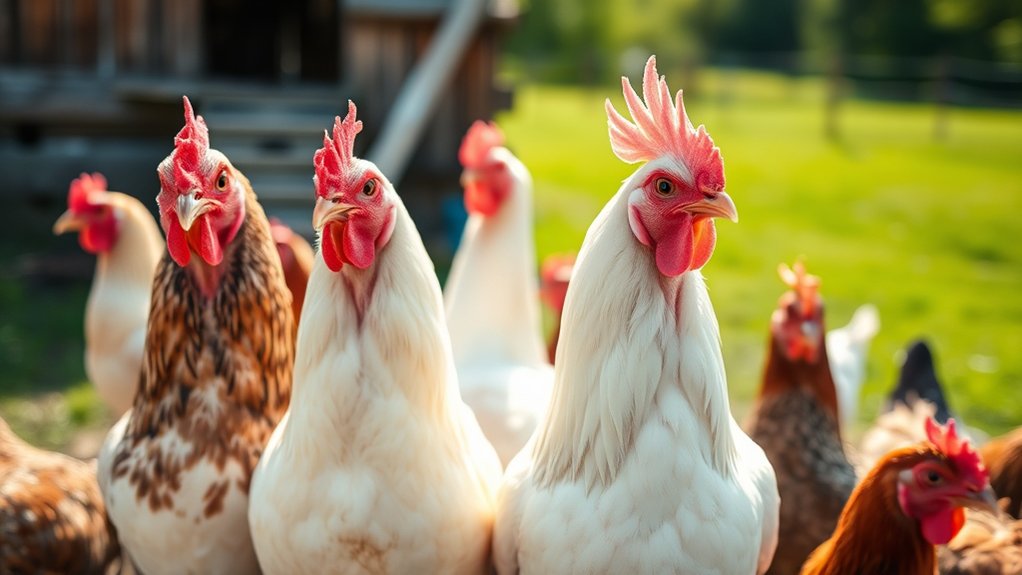
Knowing your chicken’s breed is super helpful because it lets you customize their care to what they really need. Each breed has its own unique traits that can influence their health and behavior.
And on top of that, when you know the breed, you get a better idea of how many eggs they might lay. It just makes looking after them a whole lot easier and more effective!
Breed Traits Influence Care
Because each chicken breed has unique traits, you’ll need to tailor your care to meet their specific needs. Understanding diet preferences and mating behaviors helps you provide appropriate food and manage your flock effectively.
Some breeds need richer diets, while others thrive on simpler feed. Mating behaviors also vary, affecting how you separate or group roosters and hens.
| Breed | Diet Preferences | Mating Behaviors |
|---|---|---|
| Silkie | High protein | Gentle, less aggressive |
| Rhode Island | Balanced diet | Dominant, territorial |
| Leghorn | Grain-heavy | Active, frequent mating |
| Orpington | Varied, hearty feed | Calm, social |
Impact on Egg Production
When you choose a chicken breed, you also affect how many eggs you can expect to get. Different breeds lay varying numbers of eggs, and knowing this helps you plan your flock’s productivity. Some breeds are prolific layers, while others produce fewer eggs but may offer unique eggshell variability, meaning their eggs come in different colors and shades. This can add an attractive diversity to your collection if you enjoy colorful eggs.
Breed color patterns also play a role in identifying your chickens and predicting their egg-laying habits. For example, certain breeds with distinct plumage patterns are known for consistent laying, while others with more varied patterns might lay less frequently. Understanding these traits lets you select chickens that match your egg production goals perfectly.
Key Physical and Behavioral Traits to Identify Chicken Breeds
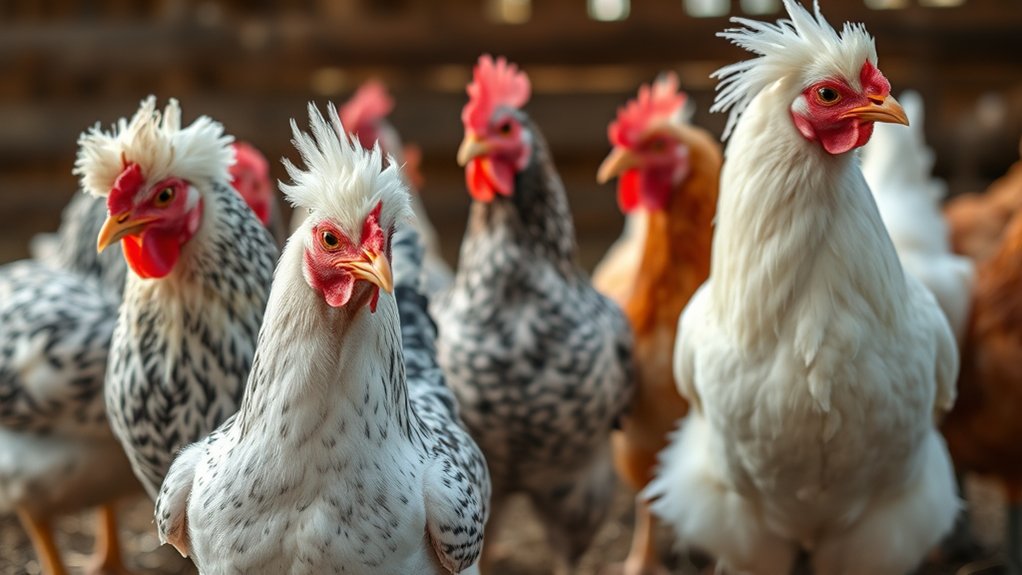
Although chicken breeds vary widely, you can spot key physical and behavioral traits that make identification easier. Paying attention to these features helps you distinguish breeds without relying solely on color or patterns. Focus on:
- Feather Texture: Some breeds have smooth, tight feathers, while others might have fluffy or silky textures that feel different to the touch.
- Body Shape and Size: Look at the bird’s overall build. Heavier, stockier breeds contrast with leaner, more upright ones.
- Comb and Wattle Type: The shape and size of the comb and wattles vary considerably and are often breed-specific.
- Vocal Tendencies: Listen to their calls. Some breeds are quiet, while others are remarkably noisy or have distinctive clucks.
How Feather Color and Patterns Help Identify Chicken Breeds
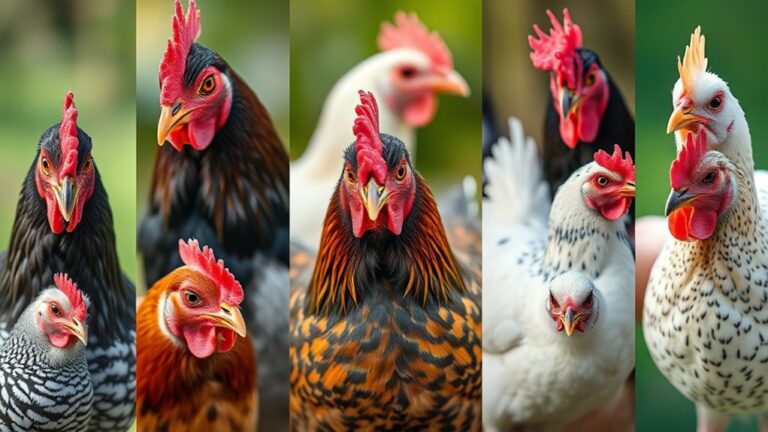
If you want to identify a chicken breed quickly, pay close attention to its feather color and patterns. These features are often the most visible clues and can set one breed apart from another. Different breeds showcase unique feather patterns, such as speckled, barred, laced, or mottled designs.
By learning these patterns, you can narrow down your options greatly. Color variations also play an essential role in identification. Some breeds come in multiple recognized colors, while others are known for a specific shade or combination.
Mastering feather patterns and color variations significantly simplifies the challenge of identifying chicken breeds.
For example, the Rhode Island Red displays a deep reddish-brown, while the Silver Laced Wyandotte shows distinct laced patterns on a silvery background. Keep in mind that even within a breed, color variations can occur, so it’s helpful to study breed standards.
Observing both feather patterns and color variations together helps you identify chicken breeds accurately without confusion.
Using Size and Body Shape to Identify Chicken Breeds
Feather color and patterns give you valuable clues, but size and body shape also play a big role in identifying chicken breeds. When you observe a chicken, focus on its overall silhouette alongside feather patterns and comb styles. These physical traits help narrow down the breed quickly.
Here’s what to look for:
- Size: Determine if the chicken is bantam (small) or standard size. Bantams are often under 2.5 pounds, while standard breeds can exceed 6 pounds.
- Body Shape: Notice if the bird has a compact, upright posture or a longer, horizontal stance.
- Breast and Back: Some breeds have broad, rounded breasts and curved backs, while others show a flat or sloping back.
- Leg Length and Thickness: Short, stout legs differ from long, slender ones, influencing the chicken’s balance and movement.
What Egg Color and Production Reveal About Chicken Breeds
You’ll notice that different chicken breeds lay eggs in all sorts of colors, from white to brown to blue-green. It’s pretty interesting to see such variety, right? Plus, egg production rates can vary quite a bit between breeds, which is helpful when you’re trying to figure out which ones are best if you want consistent laying. So, paying attention to these breed-specific egg traits can give you some useful clues about your chickens.
Common Egg Colors
Although egg colors might seem like a simple detail, they actually reveal a lot about a chicken breed’s genetics and production habits. You’ll notice color variation among breeds, with eggs ranging from white to dark brown, and even blue or green. Shell texture also varies, sometimes smooth or slightly rough, which can hint at breed characteristics.
Here are common egg colors you’ll encounter:
- White – Typical of Leghorns, known for consistent laying.
- Brown – Seen in Rhode Island Reds, with a slightly thicker shell.
- Blue/Green – Produced by Ameraucanas and Araucanas, often with a unique hue.
- Speckled – Found in some heritage breeds, adding natural camouflage.
Understanding these colors helps you identify breeds and their traits.
Egg Production Rates
How often does a chicken lay eggs, and what does that tell you about its breed? Egg production rates vary widely among breeds, revealing their primary purpose, whether for laying or dual-purpose. Some breeds lay nearly daily, offering you a steady supply, while others produce fewer eggs seasonally.
Egg shell thickness also differs by breed, influencing durability during handling and storage. Thicker shells often mean better protection, especially if you want to sell or store eggs longer.
Nutritional value can subtly vary too, depending on the breed’s diet and genetics, affecting protein and nutrient content in the eggs. By observing how frequently a chicken lays and considering shell quality, you get valuable clues about its breed’s characteristics and suitability for your needs.
Breed-Specific Egg Traits
When you examine a chicken’s eggs, the color and production patterns reveal important clues about its breed. Egg shell variation is one key trait; some breeds lay white eggs, while others produce brown, blue, or green ones. Shell thickness also varies, affecting egg durability and freshness. Understanding these traits helps you identify breeds accurately.
Consider these factors:
- White eggs often come from Leghorns, known for high production.
- Brown eggs typically belong to Rhode Island Reds or Plymouth Rocks.
- Blue or green eggs indicate breeds like Araucanas or Ameraucanas.
- Shell thickness can differ, with some breeds producing sturdier eggs suited for transport.
How Temperament and Behavior Vary by Chicken Breed
Because each chicken breed has been developed for specific purposes and environments, their temperaments and behaviors can vary widely. You’ll notice temperament differences that impact how friendly, calm, or active a breed may be.
Behavioral traits like foraging habits, social interaction, and broodiness also differ considerably. Understanding these variations helps you choose a breed that fits your lifestyle and flock goals.
| Breed | Temperament | Behavioral Traits |
|---|---|---|
| Silkie | Docile, friendly | Broody, good mothers |
| Rhode Island Red | Hardy, assertive | Active foragers |
| Leghorn | Flighty, independent | High energy, less broody |
| Orpington | Calm, gentle | Social, less flighty |
| Plymouth Rock | Friendly, curious | Adaptable, good foragers |
Knowing these temperament differences and behavioral traits helps you manage your flock better and enjoy your chickens more.
Tools to Identify Chicken Breeds
You can identify chicken breeds using a few handy tools that make the whole process easier and more accurate. For starters, visual identification techniques help you spot key features on your chicken. Then, if you want something more precise, genetic testing methods can give you exact results. And if you’re on the go, breed identification apps let you quickly compare your chicken to a database of breeds right from your phone. It’s pretty convenient!
Visual Identification Techniques
Although identifying chicken breeds might seem tricky at first, using the right visual tools can make the process straightforward and even enjoyable. Start by focusing on feather pattern recognition. Each breed has unique colors and markings.
Next, observe their vocalization differences. Some breeds have distinct calls that can help narrow down options. Then, look closely at comb shape and size, which vary widely between breeds. Finally, check leg color and scale texture, as these details also provide useful clues.
Here’s a quick guide to get you started:
- Study feather colors and patterns carefully.
- Listen for unique vocalizations.
- Examine comb type and size.
- Note leg color and scale texture.
These techniques will sharpen your breed identification skills.
Genetic Testing Methods
Visual cues like feather patterns and comb shapes offer valuable hints when identifying chicken breeds, but they can sometimes lead to uncertainty, especially with mixed breeds or rare varieties. That’s where genetic testing methods come in handy.
By analyzing genetic markers, you can get a clear, scientific identification of a chicken’s breed. DNA analysis examines specific sequences in the chicken’s genome to match them with known breed profiles.
This approach removes guesswork and provides precise results, even when physical traits overlap or aren’t obvious. Whether you’re a breeder, farmer, or enthusiast, using genetic testing lets you confirm breed heritage accurately, ensuring you know exactly what you’re working with.
It’s a powerful tool to complement traditional visual identification techniques.
Breed Identification Apps
When identifying chicken breeds, breed identification apps offer a fast and convenient solution. These apps help you quickly recognize breed diversity and understand genetic variation by analyzing photos or answering specific questions. Here’s what you can expect:
- Upload a clear photo of your chicken for instant breed suggestions.
- Access detailed breed profiles highlighting physical traits and genetic backgrounds.
- Compare multiple breeds side by side to spot subtle differences.
- Receive tips on breed care and behavior based on identification results.
Using these tools, you’ll sharpen your ability to identify breeds accurately without advanced genetic testing. Breed identification apps are especially helpful for hobbyists and farmers wanting to manage diverse flocks or preserve rare genetic lines efficiently.
Common Chicken Breeds and Their Distinctive Features
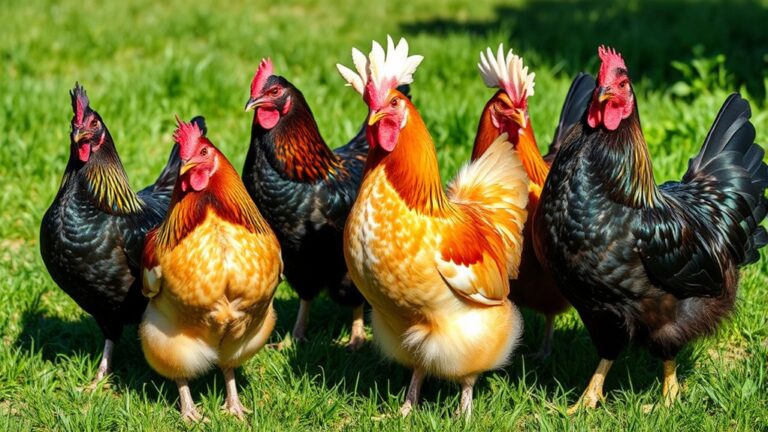
Since chicken breeds vary widely, recognizing their distinctive features can help you identify each one easily. For example, the Rhode Island Red is known for its rich, dark red feathers and hearty feather shedding during molting.
Recognizing distinctive features like the Rhode Island Red’s rich feathers makes identifying chicken breeds simple.
You’ll notice their roosters have a loud, deep crowing that carries far. Leghorns, on the other hand, sport white feathers and are excellent layers, with roosters that crow in sharp, clear tones.
Plymouth Rocks have barred black and white feathers, making feather patterns a key identifier. Silkies stand out with their fluffy, soft plumage that almost looks like fur, while their roosters crow less loudly than other breeds.
When you spot these features—feather colors, patterns, shedding habits, and rooster crowing styles—you can quickly pinpoint the breed. Understanding these traits helps you connect with your flock and appreciate each breed’s unique personality.
Tips for Keeping Different Chicken Breeds Healthy and Happy
Although different chicken breeds have unique needs, you can keep them healthy and happy by tailoring their care to match their specific traits. Start by understanding each breed’s nutritional requirements, as some need more protein or calcium than others. Next, consider their housing needs. Larger breeds require more space, while cold-hardy breeds need proper insulation.
Here are four tips to help you care for your chickens effectively:
- Provide breed-specific feed to meet their unique nutritional requirements.
- Design your coop size and layout based on the breed’s size and activity level.
- Maintain clean, dry bedding to prevent illness and discomfort.
- Monitor behavior and health regularly to catch any breed-specific issues early.
Frequently Asked Questions
How Do Chicken Breeds Affect Meat Quality and Taste?
Chicken breeds directly impact meat flavor because breed characteristics influence muscle texture and fat distribution. You’ll notice some breeds have richer, more intense flavors, while others offer milder taste.
Heritage breeds often provide a firmer texture and deeper flavor compared to commercial breeds. So, when choosing chickens for cooking, consider the breed characteristics. They’ll shape the quality and taste of your meat, making a big difference in your meals.
Can Chicken Breeds Interbreed and Produce Mixed Offspring?
Can different chicken breeds interbreed and produce mixed offspring? Yes, they can, as long as there’s breed compatibility. When you cross breeds, you increase genetic diversity, which can bring unique traits to your flock.
However, not all breeds are compatible due to size or behavior differences, so you’ll want to contemplate that before breeding. Mixing breeds can be exciting, but it’s important to manage your flock carefully to maintain health and desired characteristics.
What Are the Historical Origins of Popular Chicken Breeds?
You’ll find that the historical origins of popular chicken breeds trace back to selective breeding for traits like size, egg production, and temperament. Heritage preservation has played a key role in maintaining these unique lineages. Breed diversification happened as farmers adapted chickens to different environments worldwide.
How Do Seasonal Changes Impact Different Chicken Breeds?
Seasonal changes impact chicken breeds differently because of their temperature adaptation. You’ll notice many breeds go through a seasonal molt, shedding old feathers to grow new ones for better insulation.
Cold-hardy breeds handle winter well, keeping warm with dense feathers, while others may struggle. In warmer seasons, some breeds adjust by shedding excess feathers to stay cool.
Understanding these changes helps you care for your chickens year-round.
Are Certain Chicken Breeds Better for Beginners?
Yes, certain chicken breeds are better for beginners because they have a calm breed temperament and reliable egg production rates. You’ll find breeds like Buff Orpingtons or Rhode Island Reds easy to handle since they’re friendly and hardy.
Their steady egg laying means you won’t be disappointed, making them perfect for learning the ropes. Choosing a breed with a gentle temperament helps you avoid stress and enjoy raising chickens more confidently.
Conclusion
Now that you know what sets chicken breeds apart, you might think identifying yours is straightforward but there’s more than meets the eye. Feather patterns, size, and temperament all play a part, and each clue brings you closer to revealing your chicken’s unique story.
Ready to explore deeper and uncover secrets that will transform how you care for your flock? The adventure of discovery is just beginning. Are you up for the challenge of identifying your chicken breed?